For the Celtic Christian, there was no divided church. We walk today in that truth: one Lord, one spirit, one baptism.
So why did the Wild Goose speak to those early Celtic Christians? The Celts looked at nature and saw God revealed in all His glory and they understood God best when they took symbols from what they experienced. The Celtic believers lived in a rural world, life was lived in rhythm with creation and was made up of work, worship and rest, with everything cloaked in prayer. Thus, many Celtic prayers are associated with simple events such as rising in the morning, lying down at night, cleaning a hearth or baking bread - and they saw the creatures around them as fellow servants of God. On one occasion, Saint Cuthbert chided a young companion for not sharing a fish with an eagle who had just miraculously presented it to them for food. On another occasion, Saint Columba instructed a brother on Iona to give shelter to an injured bird which had fallen on the shore after its flight across the water.
Creation is therefore seen as an outward expression of God's nature and character, sustained by His upholding Word, and declaring His visible glory. It is not seen as a decaying, disposable utility to be exploited by man. That came with the later dualistic thinking. For too long we have simply swallowed and accepted a dualistic mindset without question, separating the spiritual and physical worlds. Often, in an unconscious way, we have simply compartmentalised our lives.
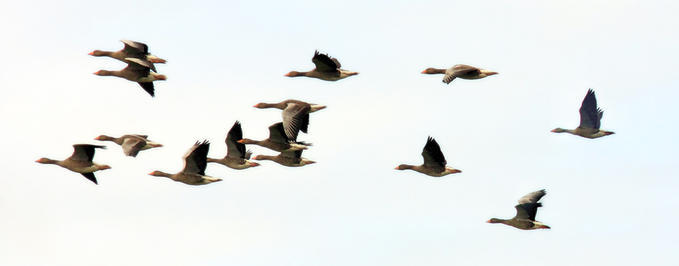
Because Celtic Christians hadn't been infected with a dualistic outlook on creation, they didn't see matter as being evil, nor the spiritual world as divorced from the material. Thus they looked on Creation around them as one great hymn of praise to its Creator, reflecting His nature and character, whilst not actually being God itself. The Holy Spirit was symbolized by the wild goose. Doves were docile and delicate, but the wild goose was untamable, free, and unpredictable. Instead of a soft coo, the wild goose was noisy and raucous. And it seemed always to be on the move on a pilgrimage (peregrinatio) ordained by the Lord Himself.
Jesus said that those Christians who were led by the Spirit were like the wind - you don't know where it comes from and you don't know where it's going. A Christian who follows the wild goose is wild and free themselves. They have lives that are less than predictable. They live life to the full (John 10:10). They are wild and free, untamable either by society that would bind them with lies or by denominations that would chain them with duty and obligation.
Celtic Christians see life as a pilgrimage, a journey. They use earthy yet poetic prayers, and have a vivid sense of saints, angels and the unseen world. They believe that what is deepest in us is the image of God. Sin has distorted but not erased that image. However, the struggle against evil in the human and the spirit world is real. Memorising Scripture, praying daily following the natural rhythm of the sun and the seasons, and working with a soul friend to overcome destructive passions are a means to strengthening us in this struggle.
A life following in the tailwind of the wild goose. That's the kind of life that calls to our innermost being and awakens the lethargic longings within.
I wish I could tell you that there are seven simple steps to achieving that life, but the truth is there aren't. Learning to fly with the Holy Spirit is to learn a different kind of life. It's learning faith and trust and how to let go. It's letting God explore the nooks and crannies of your heart-not with a candle, but with a miner's light so He can crawl down into those hidden caverns beneath our shame to excavate and alleviate the wounds. It's healing those hidden wounds and realizing they're not shameful, but that they're scars worthy of a Purple Heart medal, because we got those wounds doing battle for our soul. They're only shameful in the dark. In the light of day they are what make us strong.
There is much to learn and much to experience before we can fly with the wild goose. However, doing nothing is the guarantee that we'll never even leave the ground. So the challenge is before us - do we remain lethargic, content with being spoon-fed and led along a path that presents a narrow view? Or do we fling open the doors and windows, learn to stretch our wings and follow the wild goose wherever it may lead us? |